
Public surface vs implementation
Graftcode separates what you expose — the public programming interface — from how you implement it — business logic, infrastructure, secrets, and runtime data. The diagram below is the mental model for that split.
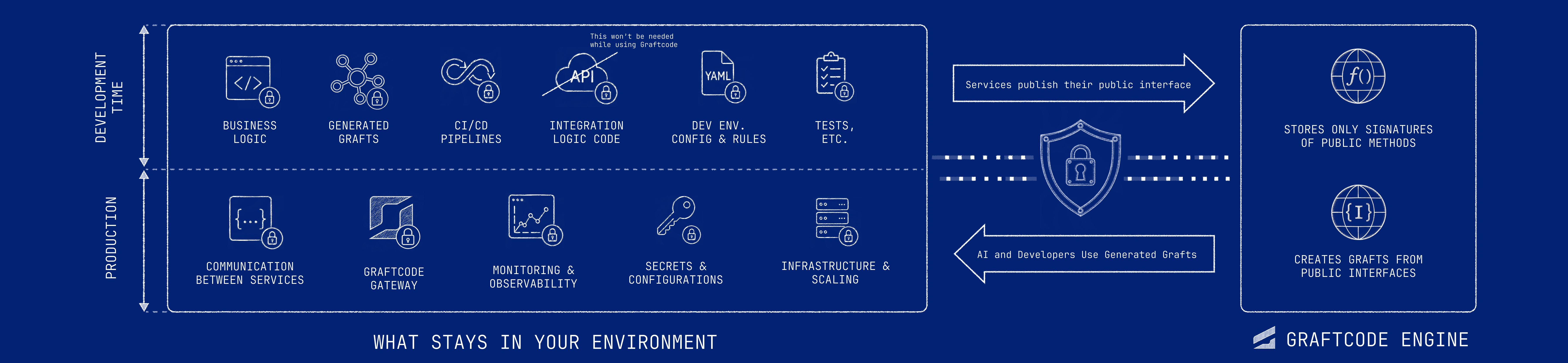
Read the figure left to right:
- Left — what stays in your environment: development and production artifacts you control. Padlocks mark categories that must not be sent to Graftcode Engine as part of contract publication.
- Center — the publication boundary: services publish their public interface outward; developers and AI use generated Grafts inward.
- Right — Graftcode Engine: stores signatures of public methods and creates Grafts from those interfaces. It is not in the normal runtime invocation path.
What stays in your environment
Development time
| Artifact | Stays local because |
|---|---|
| Business logic | Method bodies, algorithms, and domain rules execute only in your Receiver. They are not part of UGM publication. |
| Generated Grafts | Caller packages are generated from the public surface and installed in your projects. They are not a copy of your Receiver source. |
| CI/CD pipelines | Build, test, and release automation remain in your toolchain. |
| Integration logic | Adapters, orchestration, and glue behind the public surface are implementation details. |
| Dev config and rules | Local settings, feature flags, and lint rules are not callable contract metadata. |
| Tests | Verification of private behavior stays in your repository. |
Keep integration and business logic behind non-public or non-exported members. Only the intentional public surface is published — not everything marked public in source by accident.
Production
| Artifact | Stays local because |
|---|---|
| Communication between services | Runtime arguments and results travel Caller → Gateway → Receiver. They do not pass through Graftcode Engine during normal invocation. |
| Graftcode Gateway | Hosts Receiver modules and exposes transports in your deployment. |
| Monitoring and observability | Metrics, logs, and traces are emitted from components you instrument and configure. |
| Secrets and configurations | Keys, connection strings, and environment-specific values remain in your secret stores and config systems. |
| Infrastructure and scaling | VMs, containers, load balancers, and orchestration are your operational boundary. |
See Gateway and hosted modules for a category-by-category table of destinations and runtime paths.
What Graftcode Engine receives
Graftcode Engine has two jobs visible in the diagram:
- Store signatures of public methods — type names, method names, parameter types, return types, and related metadata used to build the Unified Graft Model (UGM).
- Create Grafts from public interfaces — on-demand generation of typed Caller packages for the requested ecosystem.
The Engine does not receive:
- method bodies or source files;
- private, internal, or filtered-out members;
- runtime argument values or return payloads;
- database content, secrets, or customer data;
- framework handles, streams, or other implementation types you keep off the public surface.
Publication can still reveal names in the callable surface you expose. Design that surface deliberately — see Callable surface.
Public surface vs implementation in code
| Public surface | Implementation | |
|---|---|---|
| Definition | Types and methods intentionally exposed through Gateway | Everything that executes behind those methods |
| Who sees it | Graftcode Engine (for UGM), Vision (for review), Callers (via generated Grafts) | Your Receiver process only |
| Typical contents | Small synchronous methods, primitive or plain-model parameters and returns | Persistence, HTTP clients, ORM, secrets, framework adapters |
| Design goal | Stable, portable contract across Caller languages | Freedom to refactor without breaking consumers |
Helpers, transport adapters, and framework objects belong in implementation. A small surface:
- reduces what Callers depend on;
- makes generated packages easier to understand;
- limits type-mapping failures;
- makes contract changes easier to classify.
This is a contract and exposure rule, not an authorization boundary by itself. Validate callers in Receiver methods and deployment configuration — see Authentication and authorization operations.
How analysis draws the line
The Graftcode Engine defines the boundary differently per runtime. Examples:
- .NET: exported visible types and their public declared members;
- Node.js/TypeScript: runtime exports and supported re-exports, excluding type-only and private declarations;
- Java: top-level JAR classes and declared methods (review carefully — not every declared method is intended for remote use);
- Python: module-owned classes and public functions; imported symbols and dunder names are generally excluded;
- PHP: reflected public members of discovered classes, interfaces, traits, and enums;
- Ruby: statically parsed classes and methods; dynamic metaprogramming may not appear.
Java and Ruby require particular care because discovery can include members you did not intend to expose. Python analysis imports Receiver modules; Ruby does not discover runtime metaprogramming. See Callable surface for exact rules, filters, and Vision verification.
Public does not mean supported
Discovery and package generation are separate checks. The Engine can describe a public member whose signature later fails package generation — for example when unsupported framework complex types appear on the surface.
Use Type mapping before publishing. Narrow the hosted surface with Gateway --types and method filters when needed — see Filter the callable surface.
Practical checklist
Before you publish or share a Receiver surface:
- Vision shows only the members you intend to expose.
- Package generation succeeds for every target Caller ecosystem.
- No secrets or implementation types appear on the public surface.
- Business logic remains in private or non-exported code paths.
- A runtime smoke test reaches the intended Receiver method through an installed Graft.
Next steps
- Callable surface — how Gateway selects exposed members
- Expose code as a Graftcode Receiver — shape a small public contract
- Type mapping — verify cross-language portability
- Gateway and hosted modules — where Gateway fits in your environment