
Package generation
The Graftcode Engine turns metadata from the Receiver's selected callable surface into a package for the Caller's ecosystem. It is a package/build activity, not part of each runtime call.
Flow
- Gateway identifies the selected callable surface of a hosted Receiver module.
- On a package request, the Graftcode Engine uses that callable-surface metadata and any dependency information for the selected Caller ecosystem.
- The Engine generates the target-language wrappers and
GraftConfig, then builds the requested package artifact and returns its install location.
Package generation happens once per contract/version, not on every call.
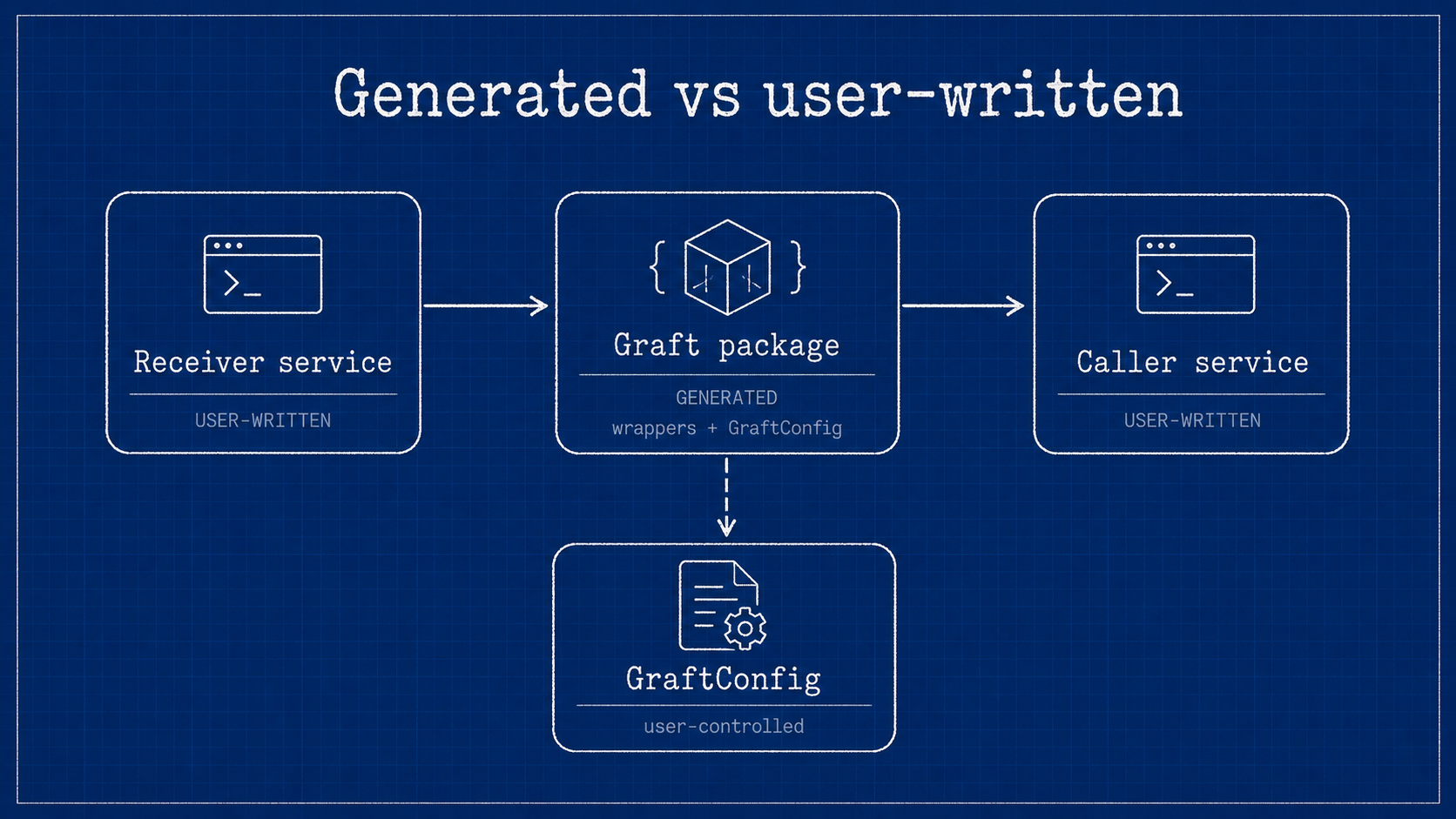
Generated and user-written boundaries
Generated:
- Caller-facing type and method wrappers;
- runtime invocation bodies;
- the package's
GraftConfig; - target package metadata and runtime dependencies.
User-written:
- Receiver implementation;
- Caller application;
- deployment configuration and policy.
Do not edit generated package code as the source of truth. Change the Receiver surface, then regenerate.
Naming and registry caveat
Package names, registry paths, versions, and install commands depend on the Receiver package, caller ecosystem, and active registry. Obtain them from the current Gateway/Vision or package-manager output. This page intentionally does not invent a naming formula.