
Invocation lifecycle
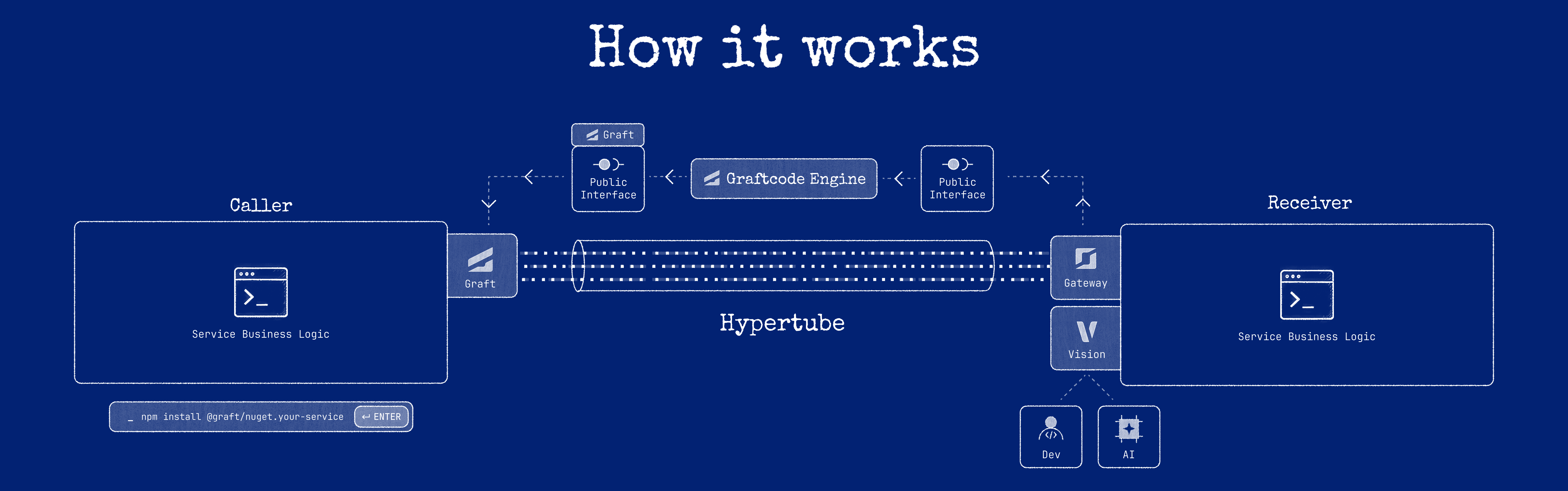
- Application code calls a generated member. Static and instance members use different generated handlers.
- The generated
GraftConfiginitializes once. It loads known environment and file sources, registers the generated default, and initializes a named runtime context. - Configuration resolution selects connection data. The winning source determines in-memory, WebSocket, HTTP/2, TCP, or plugin behavior.
- Generated code builds an operation. Instance operations carry the generated instance context; static operations target the type directly.
- Hypertube represents the call for transfer.
- The selected execution mode carries it. In-memory execution runs the Receiver in the same process; network modes send the call over the configured transport.
- The Receiver handles the call.
- The result is returned and converted back to the Caller's types.
Failure points
Failures can occur before execution (missing package or invalid configuration), during connection/transport, during dispatch, in user implementation code, or while mapping a response. Remote calls therefore require normal distributed-systems handling even though the call site resembles ordinary code.
Async, cancellation, and timeouts
Keep these four things distinct:
- Receiver internals can use async code freely — it is an implementation detail behind the public method.
- The public method contract must use portable shapes. For .NET, public methods must be
synchronous:
Task/Task<T>and cancellation tokens are not accepted on the public surface. Other runtimes vary; use the simplest supported return type for a cross-runtime contract. - The generated Caller API may be synchronous or asynchronous by runtime. For example, a generated
Node.js/TypeScript call can return
Promise<T>(youawaitit) even when the .NET Receiver method is synchronous. Follow the exact call shape in the installed package and Vision. - Cancellation and timeouts are a Caller/deployment concern. There is no built-in cross-runtime cancellation; apply timeouts, retries, and cancellation in Caller code and infrastructure. See Timeouts and retries.
What does not happen per call
The module is not re-analyzed and the Graft package is not regenerated during an ordinary invocation. Those belong to the package/build path.