
Type mapping
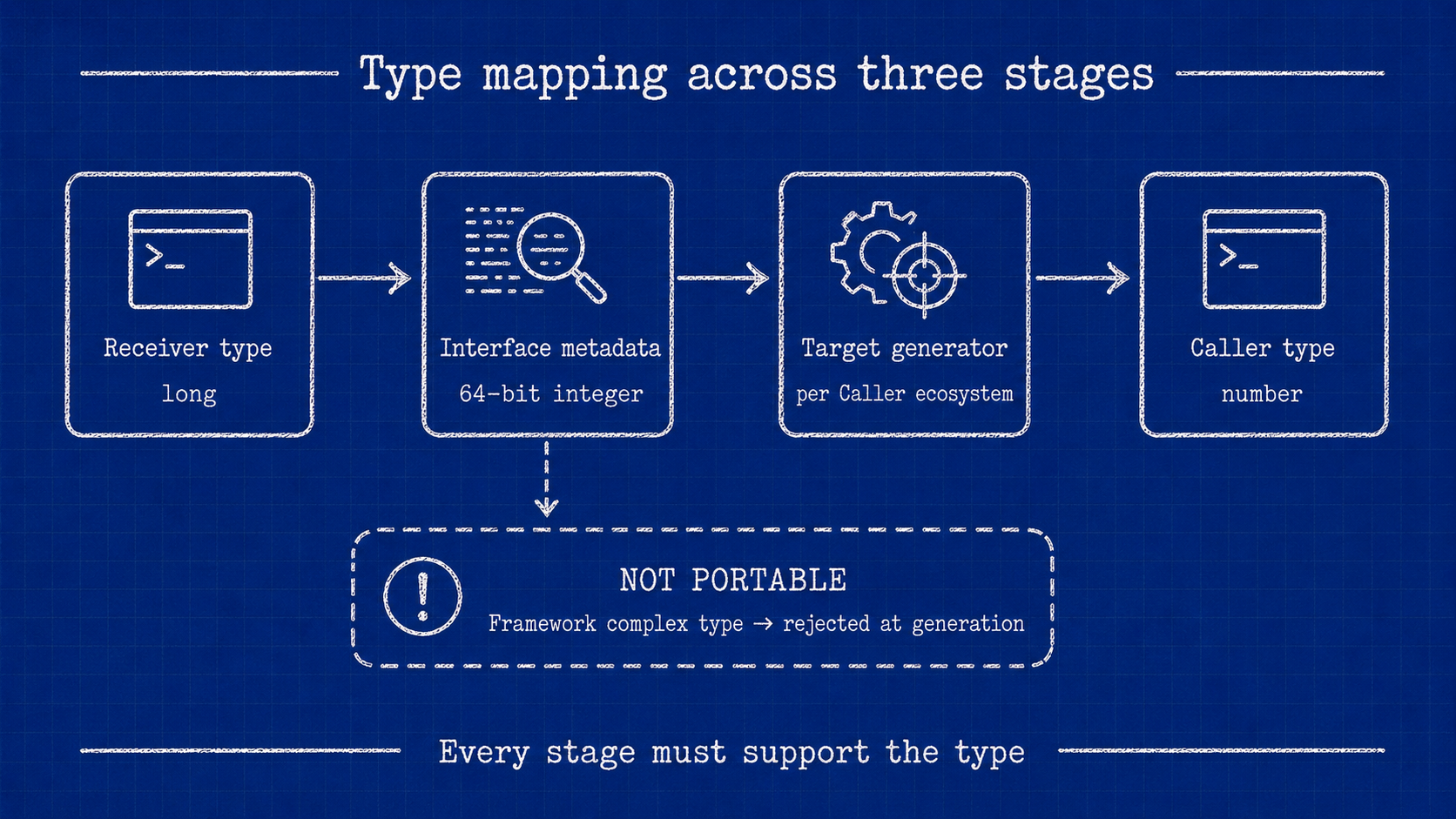
Type mapping occurs as Graftcode captures the Receiver's callable surface and generates the Caller package. Support is a property of that complete Receiver-to-Caller path—not just the source language.
Detailed mappings by target language
For generated TypeScript/JSDoc, current primitive mappings include:
- string and char →
string; - numeric primitive categories →
number; - boolean →
boolean; - void →
void; - nullable values → a union with
null; - Graft model types → generated class names.
For generated .NET, current mappings include:
- string →
string; - integer and unsigned integer →
int; - boolean →
bool; - float →
float; - byte →
byte; - char →
char; - long and unsigned long-long →
long; - double →
double; - nullable supported value types →
?; - Graft model types → generated or known local types.
Unknown values can degrade to unknown in TypeScript or object in .NET, except where an unresolved local class is recognized.
Portable baselines for all generated Callers
Graftcode also supports Java/JVM, Python, PHP, and Ruby, with cross-runtime smoke coverage. Their conservative public-contract baselines are:
- Java/JVM:
String, primitive numbers,boolean, plain Java objects, and homogeneous arrays. - Python:
str,int,float,bool, simply typed classes, and homogeneouslist[T]values. - PHP:
string,int,float,bool, typed plain classes, and homogeneous sequential arrays. - Ruby:
String,Integer,Float, booleans, small value objects, and homogeneousArrayvalues.
These are interoperability baselines, not exhaustive mappings. Boxed and nullable values, unions, enums, records, generics, maps, framework collections, date/time classes, arbitrary object values, and inheritance require verification for the exact Receiver-Caller pair.
Caller-side asynchronous syntax also does not change the Receiver contract automatically. For
example, a generated Node.js call can return Promise<T> even when the .NET Receiver method must
remain synchronous.
Runtime support and per-runtime notes
- Supported runtimes and package managers — which runtimes host Receiver code and act as Caller.
- Runtime-specific notes — per-runtime type and contract caveats.
Perl and Python 2.7 have no generated-package or type-mapping path.
Supported surface is stricter than discovery
The Graftcode Engine rejects framework complex types in public interfaces (System.DateTime is a typical example). Therefore, a type appearing in the discovered surface does not prove that package generation will accept it.
Use simple primitives and explicitly modeled public types. Prefer ISO-8601 strings and string identifiers for cross-language contracts unless the exact Receiver/Caller pair has generation and runtime tests for richer types.
Collections, generics, callbacks, and nullability
Graftcode handles arrays, generics, delegates, nested types, and nullable metadata, but support varies by language pair. Verify each intended language pair with a generated-package smoke test.
This is not a complete compatibility matrix. Confirm richer types for the exact Receiver/Caller pair before relying on them.