
Configuration resolution
Generated Grafts include GraftConfig (or an equivalent configuration type). On first initialization,
it loads known sources, registers a package default, and asks Hypertube for the named configuration.
Field naming and helper APIs differ by runtime—copy them from Vision.
Priority order
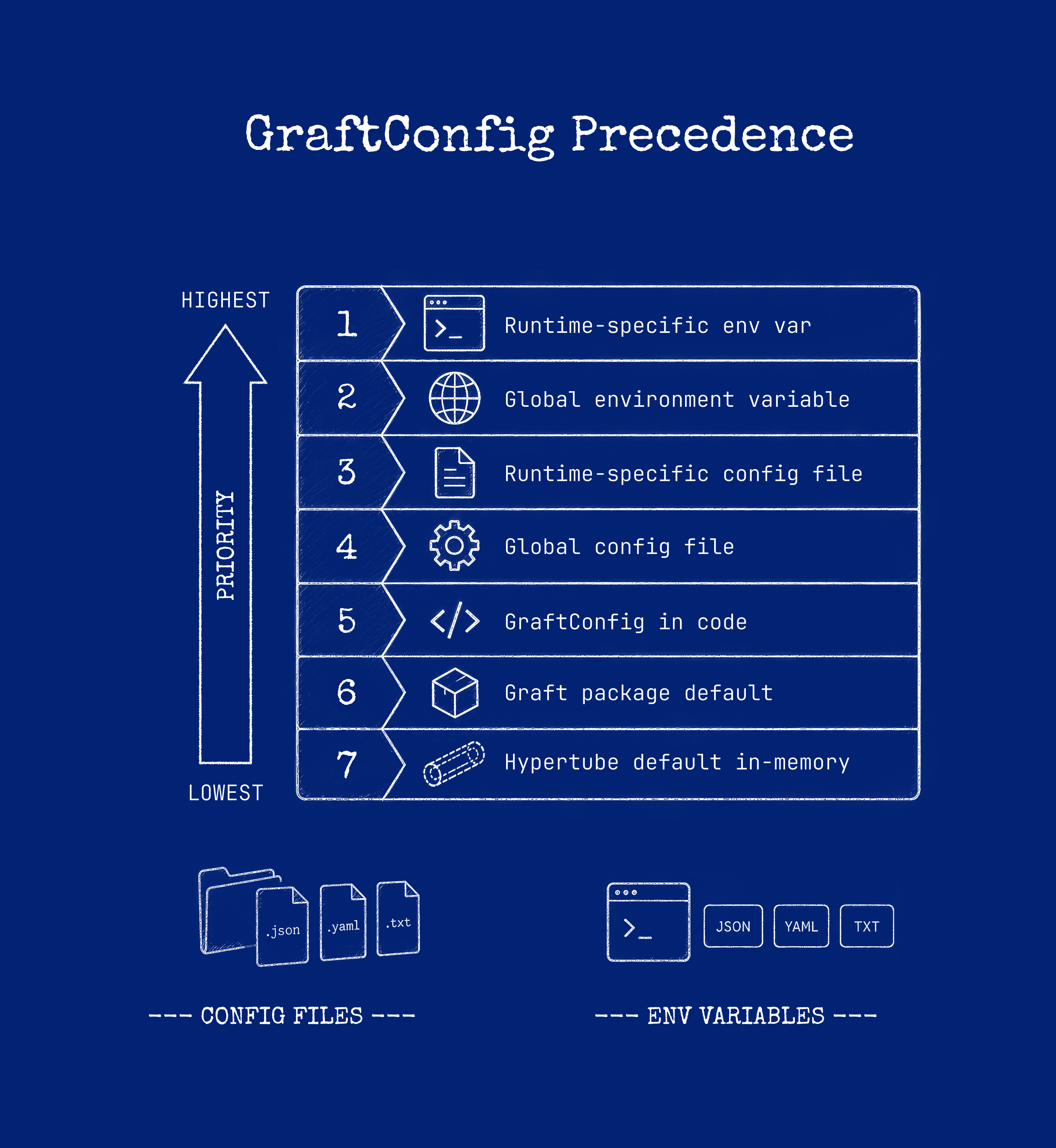
Graftcode resolves configuration in this order (highest priority first):
- runtime-specific environment variable;
- global environment variable;
- runtime-specific file;
- global file;
- user configuration supplied through
SetConfig/setConfig; - generated library default.
This order means environment and file sources override a programmatic user configuration. At the same name and priority, the first added configuration wins.
Generated source names
Generated templates attempt:
<graft-name>-configenvironment variable;graftcode-configenvironment variable;<graft-name>-config.json,.yaml, or.txt;graftcode-config.json,.yaml, or.txt.
Relative file paths resolve from the application's current working directory. The generated default uses the package's graft name, runtime, module, Host/host (default inmemory), and Stateless/stateless.
Accepted content
The resolver accepts JSON, YAML, or semicolon-delimited connection-string data. JSON and YAML use a top-level configurations object. A connection string requires at least name and runtime; normal generated defaults also specify modules, host, and stateless.
Initialization timing
GraftConfig caches its runtime context. Change static configuration fields or add sources before the first generated call. Generated packages do not expose a supported reset/re-resolve operation.
Remote host example
GraftConfig.Host = "ws://localhost/ws";GraftConfig.Stateless = true;
.NET and Node.js are fully covered; other generated runtimes follow the same conceptual model — confirm behavior in the installed package.