
Authentication and authorization operations
Four security concerns are separate and must not be conflated (see the canonical Project Key, registry, host, and credentials):
- Transport encryption — TLS/WSS on the network hop.
- Invocation authentication and authorization — proving and checking the identity behind a call.
- Registry/package access — who can install a generated Graft.
- Callable-surface execution control — which methods Gateway will accept at all.
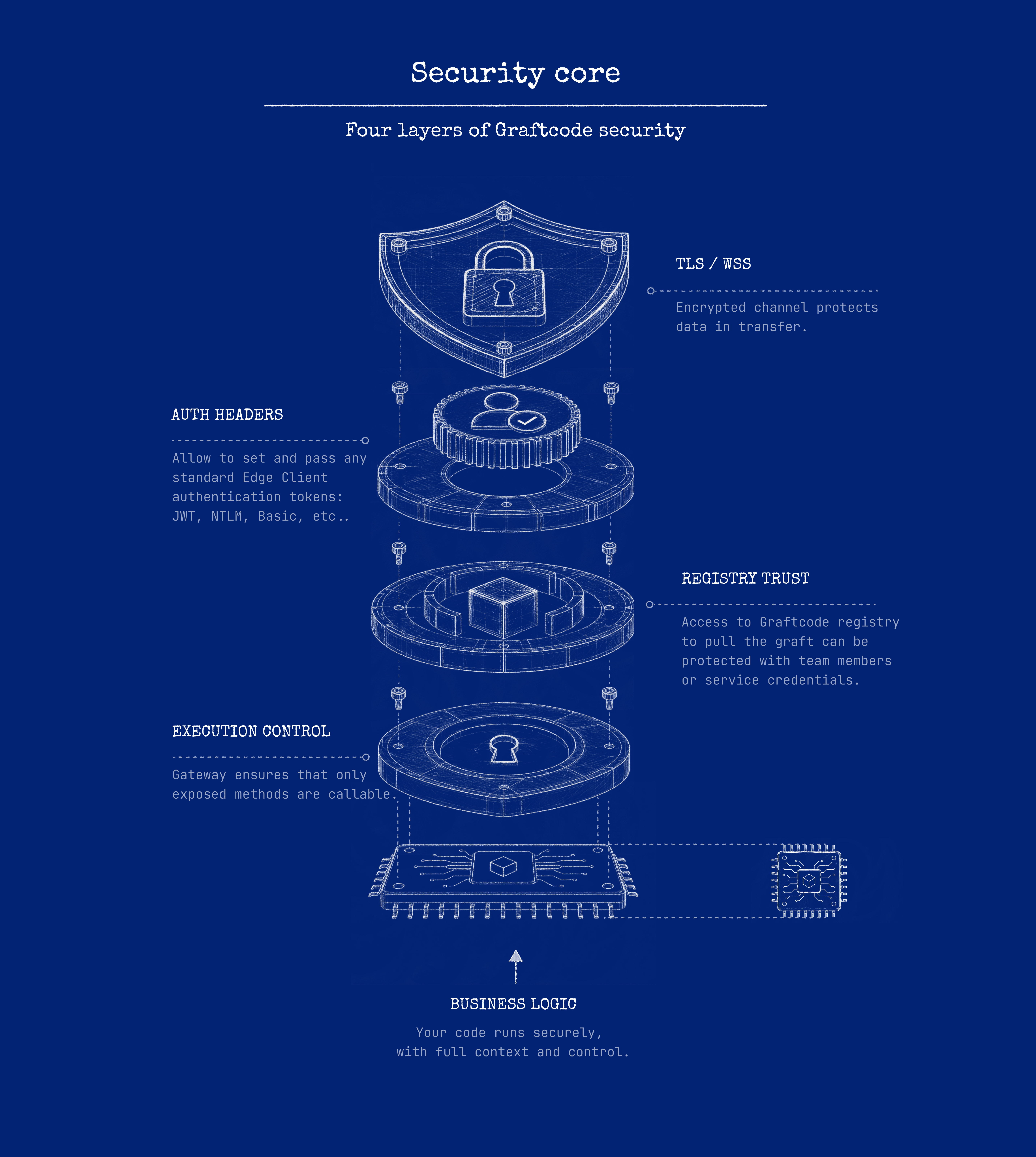
Receiver business logic remains in the Receiver-controlled environment. During a normal invocation, runtime payloads travel from the Caller through the configured transport to Gateway and the Receiver; they do not pass through Graftcode Engine (see the canonical data boundary). The Project Key associates Gateway with a project; it is not proof that a runtime call is authorized.
Recommended approach (current release)
- Terminate TLS/WSS at reviewed ingress or a reverse proxy in front of Gateway. Use
wss://(orhttps-based transports) from the Caller to that endpoint. - Authenticate each invocation by passing a token or API key as a supported method parameter, or through the generated header helpers, and validate it in the Receiver before any business effect.
- Authorize in the Receiver's business boundary (method-level checks), default deny, and keep policy independent of transport.
- Restrict registry/package access so only intended Callers can install the Graft.
Pass a token as a supported method parameter when you need the most portable path (it works in every runtime and in browser Callers). Use generated header helpers when a per-call header fits better:
Example header configuration (copy exact API names from Vision):
GraftConfig.Host = "wss://service.example/ws";GraftConfig.Stateless = true;GraftConfig.SetHeaders(new Dictionary<string, string> {["Authorization"] = "Bearer <token>"});
Multi-user Callers: prefer per-invocation identity
GraftConfig header configuration is process-wide. In a multi-user application, do not store one
user's token in shared static configuration. Instead, pass the caller's identity as a per-invocation
method parameter (or a per-call header where supported) so each call carries the correct identity, and
authorize it in the Receiver.
TLS and WSS
TLS/WSS is encrypted across the configured hop. When TLS terminates at ingress or a reverse proxy, the hop from there to Gateway is a separate connection and may be unencrypted unless you configure it; do not describe this as end-to-end encryption. Gateway does not provide native certificate configuration, so terminate and manage TLS at reviewed infrastructure. Browser WebSocket handshakes cannot set arbitrary custom headers; use only the HTTP/2 configuration emitted by Vision when a header-based workflow is required in the browser.
Status: Passing a token as a method parameter is Available in every runtime. A JWT security plugin is Alpha/Preview; its packaging, configuration, and cross-runtime support are not yet a generally available feature, and automatic credential propagation must not be assumed.