
Scaling Gateway Receivers
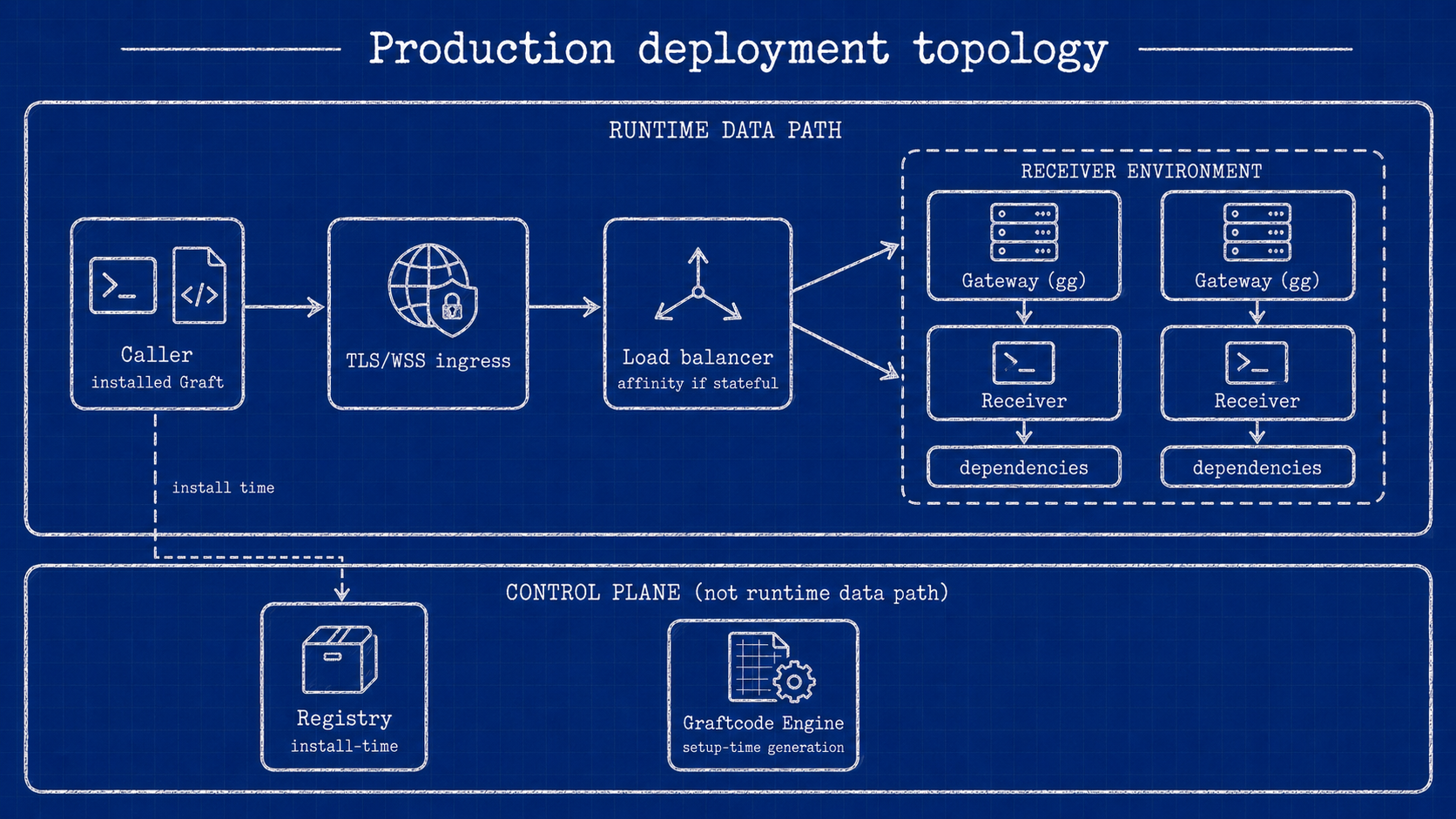
Production topology: stateless calls fan out across replicas; stateful calls stay pinned by connection affinity. The registry and Graftcode Engine are control-plane services, not part of the runtime data path.
Stateless Receivers
Static, stateless methods are the safest scaling unit. Run identical Gateway/Receiver instances behind infrastructure that supports the selected transport. Route each independent call to any ready instance.
Keep module, Gateway, generated-package, and configuration versions aligned across the pool. Remove an instance from readiness before stopping it.
Stateful Receivers
Instance methods and complex remote objects can retain identity on one receiver. Keep the connection and session on the same Gateway instance with WebSocket-aware affinity. Scale-in or restart can invalidate that identity; callers must recreate state or fail clearly.
Capacity
Measure Receiver duration, concurrent connections, CPU, memory, dependency limits, and error rates. Scale on observed saturation rather than assuming one call maps to one lightweight request.
Publication identity
Use one reviewed project identity strategy. A project key gives stable project-backed registry addressing, but it does not replace load balancing or runtime-call authorization.
Graftcode does not provide a built-in autoscaling formula, connection-drain API, distributed object-state store, or transparent state migration. Test infrastructure compatibility for WebSocket, and for optional TCP or HTTP/2 traffic, in your own environment.