
Ports and protocols reference
| Default port | Surface | Enabled by default | Configuration |
|---|---|---|---|
80 | WebSocket runtime calls | Yes | --port |
81 | HTTP server for Graftcode Vision | Yes (--GV) | --httpPort |
82 | TCP runtime calls | No | --tcpServer --tcpPort <port> |
83 | HTTP/2 runtime calls | No | --http2Server --http2Port <port> |
For generated WebSocket clients, copy the full ws:// or wss:// host, including path, from Vision.
The local route is /ws; do not extrapolate routes for other transports.
Transport support
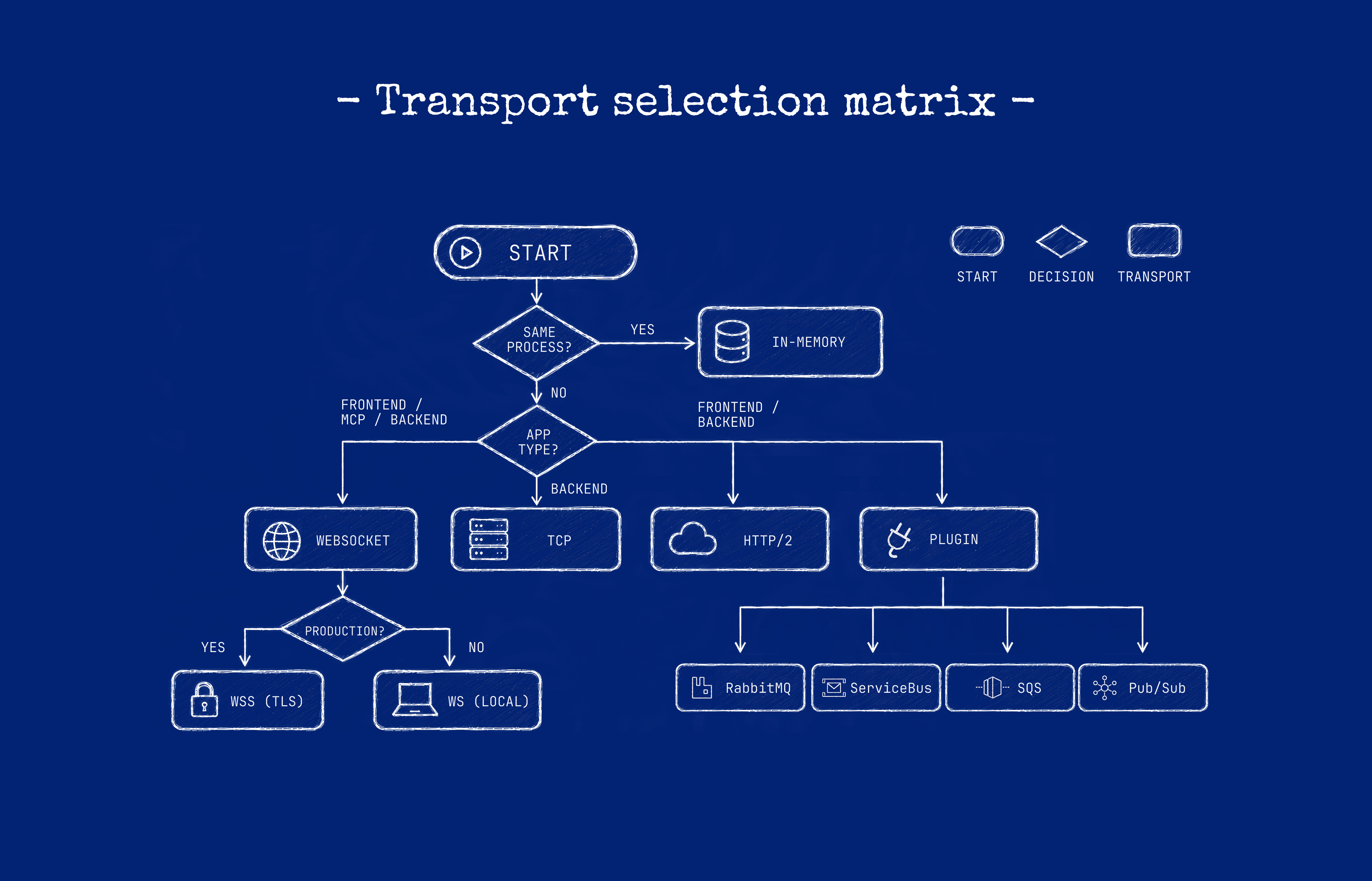
"Transport agnostic" means business code is decoupled from a selected transport, not that every transport has identical semantics. Choose the runtime host accordingly (see Execution modes).
| Transport | How to select | Status |
|---|---|---|
| In-memory | host = inmemory | Available (built-in) |
WebSocket (ws://, wss://) | ws://host/ws or wss://host/ws | Available (built-in, default) |
| TCP | tcp://host:port (or host:port); enable --tcpServer | Available (built-in, opt-in) |
| HTTP/2 | HTTP(S) host ending in h2; enable --http2Server | Available (built-in, opt-in) |
| Message queue / broker (Kafka, RabbitMQ, NATS, SQS, service bus) | Server plugin via --config | Preview / plugin-based; availability depends on the specific plugin |
Only in-memory, WebSocket, TCP, and HTTP/2 are built-in. Any queue or broker transport requires a transport plugin; do not assume a broker is supported because it appears in a diagram or design. WSS and HTTP/2 do not have identical failure or header semantics — see Authentication and authorization for the browser header constraint.
Gateway defaults may require elevated privileges or conflict with another web server. Change ports or container host mappings as needed. Open only selected listeners through firewalls and security groups.
TLS/WSS termination is infrastructure-specific. Gateway does not provide native certificate flags. Browser WebSockets cannot attach arbitrary custom handshake headers; when headers are required, use only the HTTP/2 endpoint/configuration emitted by Vision.
CORS affects browser HTTP surfaces and is configured with --corsAllowedOrigins or --corsConfig;
it is not a substitute for authentication.
The HTTP listener also serves a built-in GET /status liveness endpoint (returns 200 OK). No
dedicated metrics port, MCP route table, maximum message size, idle timeout, or proxy configuration
is provided.